Thursday, December 16, 2010

Theory of computation - Regular, CFG, Recursive languages

Identities of regular expression
1) R*R* = R*
2) (R*)* = R*
3) RR* = R*R
4)(PQ)*P =P(QP)*
3) (a+b)* = (a*b*)* = (a*+b*)* = (a+b*)* = a*(ba*)*
 example simplify ((a*b*)* (b*a*)*)*
   = ((a+b)*(b+a)*)*
   = ((a+b)*(a+b)*)*  //set union is commutative that is a+b = b+a
   = (a+b)*                  //using above 1) and 2)
6) ∅ + R = R
7) Rε = R
8) ∅* = ε
The empty set  ∅ = {} is not the same as the empty string ε. So {}* = {ε} != {}.

Example simplify  ∅* + a* + b* + (a + b)*
since  ∅* ={ε} and ε subset of (a + b)*
a* and b* are also subset of (a + b)*
i.e a* + (a + b)* =(a + b)*
so its (a+b)*


Properties of Regular expressions
1. Associativity
associative over both Union and Concatenation
a+(b+c)=(a+b)+c  and (ab)c =a(bc)

2)Commutative
over union only
a+b = b+a  but ab != ba

3)Distributive 
Concatenation over union
 both left and right distributive
 a . (b + c) = a.b + a.c  and also (a+b).c = a.c+b.c
Union over concatenation
 not distributive that is b+(a.c) != (b+a ). (b+c)

4)Identity
R+∅ = R  // for union
R.ε =R  // for concatenation

5)Annihilator
For concatenation  ∅ is annihilator
R.∅ = ∅
For union no annihilator


Practice problems
http://www.cs.utexas.edu/~cline/ear/automata/CS341-Fall-2004-Packet/2-Homework/

Finite Automata
  • with output
    • Moore m/c
    • Mealy m/c
  • without output
    • Deterministic for each input there is one and only one state to which automata can transition from current state
    • Non deterministic automata can be in several state at once
    • epsilon NFA

Deterministric Automata
Five tuple A = (Q,Σ,δ,q,F)
1. A finite set of states, often denoted Q
2. A finite set of input symbols, often denoted Σ
3. A transition function that takes as arguments a state and an input symbol and returns a state
The transition function is commonly denoted δ
δ(q,a) =p
4. A start state, one of the states in Q
5. A set of final or accepting states F (F ⊆ Q)

Note In transition table the new state on any input is single unlike NFA where its set of states


Non deterministic Automata
  • can be several states at once
  • each NFA accepts language that is accepted by some DFA 
  • easier than DFA
  • we can convert NFA to DFA
  • Transition function δ(q,a)  returns set of states {p1,p2,p3..}
DFA has almost as many states as NFA but has more transitions
In worst case DFA can have 2^n states when correponding NFA has n states

A NFA is allowed to make transition without getting any inputs called epsilon transition, this does not affects the class of language accepted but make implementation easier


For every DFA  there is equivalent RE
For every RE there is equivalent eNFA

DFA ---------->  RE
State Elimination Method
Eliminates states of the automaton and replaces the edges with regular expressions that includes the behavior of the eliminated states.
Eventually we get down to the situation with just a start and final node, and this is easy to express as a RE

1)If more than one final state make it single final state with all final going to this new

2)If the two states are different, we will have an automaton that looks like the following:

Note
when eliminating the state we take care to loop for all the possible loops that go through that state


Closure properties of regular language
we say language L is closed under operation X if the output of X is in L whenever inputs are in L.
Regular languages are closed under

1)Union and Intersection
cross-product of the two DFA will recognize union and intersection of two languages

2)Set complement
if we make non final states as final and final states are non final states, we get a DFA accepting the complement of language

3)String Reversal
pick NFA recognizing the languag. create new final state with epsilon transitions from old state then swap the start and final states and change directions on each transition we have a NFA accepting the reversed string

4)Set difference
can be rewritten in form of intersection and compliment

6)Concatenation and star

5)Homomorphism (substitution of string for symbols)
It is function from string ---> string  . Its output on multicharacter string is its output on individual characters in string
h(xy) =h(x)h(y) for any string x and y
Since we can always write regular expression for any homomorphism of regular language its closed under homomorphism

6)Inverse Homomorphism


Regular language not closed under
1)Subset and Superset operations


Homomorphism
consider symbols of language L as {a,b} and Homomorphism H symbol set as {a,b,c}
h(a) =ab ,h(b) =bbc then
h(aba)=h(a)h(b)h(c) = abbbcab
The homomorphic image of language L1 ={aa,aba} is h(L1) ={abab,abbbcab}

Decision properties of Regular Language
1)Membership
Is string w in regular language L?
If string w is accepted in the FA of language L then its member

2)Emptiness
Is L = ∅ ?
Remove all unreachable states and edges from the FA for the language L and then check if it has any final(accepting) state. Use graph reachability algorithm to check.

3)Finiteness
Is L finite language?
A regular language is not necessarily finite
DFA method
Remove states that are not reachable from the start state and all states that donot reach an accepting state from the DFA
If there are any cycles in the remaining DFA then it is infinite else finite
Regular Expression Method
If there are any * in the RE then it should be infinite but there are exceptions like
0ε*1 is not infinite nor is 0*∅  so we need to eliminate ∅ and ε equivalent expressions from RE
Remember
E+F is equivalent to ∅ iff both E and F are equivalent to ∅
EF is equivalent to ∅  if either E or F is
ε is not equivalent to ∅ neither is E*

E+F is equivalent to ε iff both E and F are equivalent to ε
EF is equivalent to ε  if both E and F are
E*  is equivalent to ε iff E is 

4)Equivalence
in product automaton LxM
final state pair for which exactly one final state of q and r
the language accepted should be empty for equivalence

5)Containment
Is L subset of M?
in product automata LxM
make those pair as final state for which only L is final and M is not
the language accepted should be empty for containment

make


Non Regular Language
Not recognized by finite automata
Finite automata cannot distinguish infinite string because they have limited memory

Myhill-Nerode's theorem
Indistinguishable strings
String x and y in Σ* are indistinguishable with respect to language L if and only if every string z like xz, yz are both in L or both are not in L
1)choose z
2)append z to strings
3)and check new string  whether they are in language or not
example  Check whether a and aa are indistinguishable with respect to language {an} over alphabet a
1)we choose string z in Σ* to be ak ,
2)check string of form aakand aak, for every k this strings are in language
3)so this strings are indistinguishable

Theorem
Theorem : A language L over alphabet Σ is nonregular if and only if there is an infinite subset of  Σ* , whose strings are pairwise distinguishable with respect to L.

Example Let L1 = { anbn | n is a positive integer } over alphabet { a , b } show its nonregular using Myhill-Nerode
1)Consider the set of strings S1 = { an | n is a positive integer } . S1 is over alphabet { a , b } and it is infinite. We will check for its strings and try to show that they are pairwise distinguishable with respect to L1.
 2)Let x= ak and y= am be two strings of the set S1, where k,m >0 and k != m .
3)Select z= bm as a string to be appended to ak and am  .
4)we see that akbm is not into L1 while ambm is in L1 .
Hence ak and am are distinguishable with respect to L1 . Since ak and am are arbitrary strings of S1, S1 satisfies the conditions of Myhill-Nerode theorem. Hence L1 is nonregular.

Pumping Lemma : Suppose that a language L is regular. Then there exist integer n > =1  such that for any string x in L with |x| >=  n(pumping length), there are strings u, v and w which satisfy the following relationships:
            x = uvw
            |uv| <= n     // loop appears within first n letters where n is pumping length
            |v| > 0   and 
            for every integer m >= 0, uvmw element of L.   // v is the repeated string or one that loops

  • Pumming lemma follows from simple pigeonhole rule that if  number of symbols is at least the size of string in the language then atleast one state must be repeated.
  • pumping length n is the number of states in the FA
  • v is the string that is repeated.choosing v to be of at least one letter assures that loop appears within first p letters
  • so we chose a string x of length at least n  and try to prove that there is some repeated state

Pumping lemma gives necessity condition for language to be regular but its not the sufficient condition i.e even if we prove pumming lemma for language L its not necessarily  regular language

Context Free Grammar

Closure Properties
1)Union
Is L1 U L2 a CFL?
closed under union
by adding a new rule for starting symbol like S->S1|S2

2)Concatenation and closure
closed under both
for concatenation add S1->S2
for kleen closure add S->S1|S|e

3)Homomorphism
closed under homomorphism

4)Substitution
Homomorphism is special case of substitution
closed under substitution

5)Intersection
not closed under intersection

6)Intersection with Regular language
L1 CFL and L2 regular then L1 intersection L2 is CFL

7) Complementation

not closed as would mean intersection is closed which is not
¬(¬L1 ∪ ¬L2) = L1 ∩ L2 

8)Set difference
not closed under set difference

8) Set difference with Regular language
L1 CFL L2 Regular then
L1-L2 =L1 intersection L2'
which is CFL so its closed under CFL

9)Inverse Homomorphism
closed under inverse homomorphism

Decision problems of CFG
Decidable
1)Emptiness

2)finiteness

3)membership

Undecidable
1)equivalence L1 and L2 CFG then is L1=L2?
2)Inclusion or containment 
can L1 generate all string generated by L2?
3)is CFG for language ambigous
4)Universality
Does it generate the language of all strings over the alphabet of terminal symbols used in rules
Is L(G) = Σ*?
5)given context sensitive grammer does it describe CFG or
6)given CFG does it describle Regular language


If grammar G is in CNF any derivation of string w has 2n-1 steps for |w|=n


Problem  DFA recognizing L = {x ∈ Σ∗ : 1110 is not a prefix of x}.
Solution

CYK algorithm
//incomplete for now
To check if membership property of CFL

when blank inthe table ?
when S inthe table ?


division for substring of size 3  aab can be
aa  b
a ab
which can be solved by looking at level 2 and level 1 only

for substring of size 4
division can be
a aba
aab a
which can be solved by looking at level 1 and 3
aa ba
which can be solved by looking at level 2

for substring of level 5
division ca be
a abaa
aaba a
 looking at level 1 and 4
aab aa
aa baa
level 2 and 3


Pushdown Automata
like NFA with stack(unlimited memory assumed), stack provide additional memory which help recognize some non regular languages
NPDA equivalent in power to CFG
PDA can write symbols(push) on the stack and read them(pop) back
LIFO
DPDA and NPDA are not equal in power. Expressive power of NDPD more than DPDA
NPDA can recognize languages not recognized by DPDA  unlike DF and NF in regular grammar which accepts same set of languages

Theorem
A language is context free if and only if there is some pushdown automata that recognizes it and also
If PDA accepts any language then its CFL

Theorem
L1 be set of languages accepted by PDA by empty stack L2 be set of languages accepted by PDA by final state then L1=L2

Fig. state transition in PDA


Difference between NPDA and PDA
language like L1= {wwR|w (a+b)*}  and L2 = {aibjck | i=j or j=k}
needs non determinism to recognize them
In Language L1 at each point we need to nondeterministically guess middle of string and in L2 we need two state on transition from a to b from one state we check for c also by popping and on other we check for b by popping
L1 can be converted such that its accepted by DPDA by including some middle marker in it.


Non Context Free Languages
L3 = {ww| we(a+b)*} is not accepted by PDA because the here we need FIFO but stack is LIFO
while complement of L3 is CFL

L4 = ({aibjck | i,j,k= n }
Its not accepted by PDA because we can either match a with a or c. It requires two memory elements
Complement of L4 is also CFL

L5 = {aibjckdm | i,j,k= n }

Check for Non CFG

1) denote each symbol power in form of variable i j k ..
 If language L6= {anbncm | n,m >=1} convert it to {aibjckdm | i=j=n,k= m, i,j,k >=1}
check if more than one comparision required (more than one memory element required) in variables i, j, k..
 for above language we have only one comparision i=j so its CFL
For language L7 = {ambncmdn  m,n>=1} we convert it to {abjckdl   i=k, j=l i,j,k,l >= 1}
we see there are two comparisons so its not a CFL

2)Check if FIFO is required if so not a CFL
example L= {ww}

3)If language is over single alphabet then it behaves similar to Regular grammar, that is, It is CFL only if the length of string(power of letter) is in arithematic progression
example L8={an2 | n>=1} and  L9={an! |n>=1} are not CFL


Recursive and Recursively Enumerable
A language L is recursively enumerable(re) or Turing Acceptable if there exists a TM M such that L=L(M) or some TM accepts the language L.For a string not in language it may halt or may loop forever unlike recursive language
A language L is recursive(r)  or Turing Decidable if there exists a TM M such that L=L(M) or L is accepted by some TM and M halts on every w∈ Σ+ .
For recursive language a membership algorithm  exists.
For string not in language it should halt in non final state
that is L' is also recursive or is decidable

Non recursively Enumerable L'
If a language is not accepted by TM then its non recursively enumerable that is there is no algorithm to describe the language
L' is not recursively enumerable and hence not recursive

Recursive enumerable but not recursive
that is there exist a TM that accepts the language but doesnot halt on some input
or There exists a recursively enumerable language that is not recursive.
Universal language Lu is example.

If languages L and L' are both RE, then L is recursive.
implications
if L is not RE then L cannot be recursive
if L' is not RE then L is not recursive
if L is RE but not recursive then L' is not RE

If L is recursive, then L' is recursive.
If G is an unrestricted grammar, then L(G) is recursively enumerable.


Problem Consider language L1, L2, and L3 are recursively enumerable over the alphabet Σ such that
(a) Li ∩ Lj = Φ when i ≠ j; and
(b) L1 ∪ L2 ∪ L3 = Σ*
Prove that L1 is recursive.
Solution
We know that language is recursive if L and its complement L' are both RE
L1 is RE, we check L1' which is (L2 U L3)
L2 , L3 are recursive enumerable and we know that RE are closed under union, so L1' is also RE
Hence L1 is Recursive.

Problem Prove that L* is recursive if L is recursive
Solution Kleen closure is defined in terms of union and since recursive language is closed under union L* is also recursive

Problem 
1) If A is regular and B is regular, then A ∪ B'
regular because regular languages are closed under union and complementation

2)If A is regular and B is context free, then A ∪ B'
A is also context free because every regular language is context free
complement of B may not be CF because context free languages not closed under complementation
So we cannot say whether regular or context free grammar here, we check for recursive language here
B is context free so is recursive also and recursive languages are closed under complementation so B' is also recursive . Similarly we can prove its Recursive

3)If A is context-free and B is regular, then A∪ B' is
Context Free

4)If A is recursive and B is recursive, then A∪ B' is:
Recursive

5)If A is recursive and B is Recursively enumerable, then A∪ B' is:
can not be deduced

6)If A is recursively enumerable and B is recursive then A∪ B' is:
Recursive enumerable

Problem Prove that if a finite set of recursively enumerable languages partition Σ∗ , then the languages are recursive
Solution
Since language complement is also recursively enumerable and we know that L and L' are recursively enumerable then L must be recursive.

Problem If L1 is recursive language. L2 and L3 are recursively enumebrable but not recursive then
1)L2 -L1
L2 -L1 = L2 intersection L1'
L1 is recursive and we know that recursive languages are closed under complementation so L1' is also recursive and every recursive language is also recursively enumerable so L1' is also recursively enumerable
, recursively enumerable language are closed under intersection so its recursively enumerable
2)L1-L3
L1 intersection L3'
L3 is recursively enumerable but complement of L3 is not necessarily recursively enumerable.
so we cannot deduce anything
3)L2 intersection L1
Recursively enumerable


Closure properties of recursive language
Recursive Languages are closed under
1)complementation
because if language L is accepted by TM M and it halts on every input then
machine M' accepts w if M rejects it and M' rejects if M accepts it.
2)difference
3)intersection.
first run on M1 and them on M2 if accepted but both then Accept else reject
4)union.


Closure properties of recursive enumerable languages
1)Recursively enumerable languages are closed under union.
For any two Turing-recognizable language L1 and L2, let M1 and M2 be the TMs that
recognize them. We construct a TM M that recognizes the union of L1 and L2.
- For the input w
- Run M1 and M2 in parallel.
- If either accept, accept
- If both reject, reject.
2)Closed under Intersection
3)Closed under kleen closure
We can use a multi tape Turing machine as all multi tapes Turing machines have an equivalent one tape Turing machine For any Turing-recognizable language L, Let M be the TM that recognizes it. We construct a TM M1 that recognizes the star of L:
On input w, split w into w1w2…wn, save each on a tape
Run M on wi for i=1,2,…,n.
If M accepts each of these string wi, accept.
If reject reached on the possible parts, reject.”
If there is a way to cut w into substrings such M accepts all the substrings, w belongs
to the star of L and M1 will accept w after a finite number of steps.


Not Closed under
5) set difference
6)Complementation (we only need to show that there is a language that is r.e. but not recursive.)

 If L is r.e. but not recursive then L' is not r.e.


Turing Machine
Unlimited and Unrestricted memory
tape as its unlimited memory, tape head to read and write symbols and move around on the tape
Difference between Finite automata
A TM can both read from and write on the tape
Read write head can move both left and right
infinite tape
special states for accepting and rejecting take effect immediately


Every Non Deterministic TM and an equivalent Deterministic TM
that is has same expressive power
A language is decidable if and only if some NTM decides it


Halting problem
recognizer are more powerful than decider
Acceptance of string by TM is called Halting problem
its undecidable

A language is decidable if both L and its complement L' is Turing recognizable
Compliment of Acceptance problem by TM is not TM recognizable else it would be decidable

Decision problem for Type 0 or recursive enumerable language
Undecidable
1)Given M ,  is L(M) regular, context-free, recursive
2)membership inclusion universality equivalence emptiness 


w ∈ L? L = ∅? L = Σ*? L1 ⊆ L2? L1 = L2? L1 ∩ L2 = ∅?
Regular
(type 3)
DDDDDD
Det. Context FreeDDDOUU
Context Free
(type 2)
DDUUUU
Context Sensitive
(type 1)
DUUUUU
RecursiveDUUUUU
Recursively Enumerable
(type 0)
UUUUUU

References
www.cs.uiuc.edu/class/fa05/cs475/Lectures/new/bwlec21.pdf     //closure
web.cs.wpi.edu/~kal/courses/cs503/module10/hw9s07solns.pdf  //good problems
http://www.soe.ucsc.edu/classes/cmps132/Winter01/         //problems on turing and recursive lan 
http://www.cs.odu.edu/~toida/nerzic/390teched/regular/reg-lang/non-regularity.html
http://www.cs.odu.edu/~toida/nerzic/390teched/web_course.html  // complete course
http://www.dhedhi.com/tazeen/CS341_F03/notes/mistakes.htm   // frequent mistakes
www2.imm.dtu.dk/courses/02140/L8-MF.pdf //decision property of regular language
http://www.cs.uiuc.edu/class/fa07/cs273/      //problem set  
www.cs.uwaterloo.ca/~watrous/360/assignments/1-solutions.pdf   //problems on prefix substrings 
http://www.cs.utexas.edu/~cline/ear/automata/CS341-Fall-2004-Packet/2-Homework/   //problems 
http://www.cs.wcupa.edu/~rkline/csc520/    //undecidable problems 

Wednesday, December 15, 2010

Abstract Datatype

Linked list
struct node{
int node;      //datapart
struct* node;  //pointer to next node structure
}
There is one head pointer pointing to node structure but treated specially  Its allocated on stack while these nodes are stored on heap with dynamic memory allocation call to malloc(int)

isEmpty(struct node*)
Input: heap pointer
If head pointer is null
 true
else
 false

int Length(struct node * header)
Input head pointer
create another duplicate pointer instead of  changing the head pointer because we donot want to lose start of list call it current pointer to struct node
here header and current pointers are local to this function only

while(!isEmpty)
count++
current= current ->next

InserAfter ( struct node ** head pointer, newdata) //insert new element at beginning of list
// head pointer by reference instead by value
allocate newNode on heap
struct node * newNode = malloc(sizeof(struct node));

here head points to the actual head pointer instead to first node


set data newNode->data = newdata
set next pointer link of newNode to remaining list newNode ->next = * head
set head of list to newNode , if we had passed copy of pointer we wouldn't be able to change it
*head = newNode
we change the head pointer only at last because we donot want to lose
call to it would be like InsertFirst(&head,data)
where head in the calling program would be defined like struct node * head

changing a pointer with reference pointer
we pass a pointer with one extra star like we did above struct node **

Common mistakes in Linked list
1)passing pointer by value when updating the head in the function
2)

Deleting Max from linked list
can be done in single pass if we maintain the maxprevious else would need two pass
Binary search on linked list
would take O(nlogn) which is more than on array(logn)


remove duplicates from the unsorted array and leave the order of numbers same
like  2 1 8 2 7 4 8 should be 2 1 8 7 4
can be done in O(nlogn) if we attach a key with all the numbers to keep track of order
first we sort according to value then O(nlogn)
remove duplicates O(n) leave keys with smaller number
sort according to keys O(nlogn)

size of stack when function is should depend on the depth of function calls
that is for permutation number of call is proportional to n
for fact also number of calls is proportional to n
when there is function call then address and variable are piled on stack and new function is free to change the registers
so when permutation(10) is called it will pile the address and variable for the main function
and it will call permute reursively until permute(1) in which it doesnot need to call any function
 _________
main call     |
------------- 
permute 10 |
------------
permute9    |
 ------------
 ________
permute2   |
------------

so 9 is the depth for the function and first call piles main block address and register values on stack

Polish Notation
prefix notation
operator before operands

Reverse Polish Notation
every operator follows its operand


Infix to postfix conversion
values are moved to output queue
when operator has higher precedence than operator on top of stack push it on to stack
when operator have same precedence as top of stack and its left associative pop top of stack and push new operator
when operator has same precedence and is evaluated from right push it
when left parenthesis is found push onto stack
when right parentesis is found pop stack top to output until left parenthesis found and discard both left and right


stack error
underflow trying to pop empty stack and overflow trying to push onto already full
array can be shared to allow two stack implemented in same
Queue

FIFO
The queue has head and tail
element is added at tail and removed from head
head(Q) indexes head of the queue that is the fist element in fifo sequence
tail(Q) points to next location at which new data will be inserted, one ahead of last lement
we wrap around when tail reaches the end of the queue + 1

Enqueue operation inserts element at the tail and moves tail ahead by one to point to next empty
Dequeue operation removes from the head and moves head to point to next element

In circular queue when head points to the first element and tail points to the last element there is problem to check the empty and full condition because when
tail = front - 1  it can be empty or can be full
solution to this problem involves using additional varible which keeps count of number of elements or
keeping a gap between head and tail by one null space


Stack with one queue (circular)
operation we need push and pop
order we need is LIFO
adding element to queue should not be problem because we can enqueue element at tail now to delete
we can delete from front only by dequeue operation so we need to move all elements after rear that is dequeue each element until last, remaining list will be in same order as before

Queue with two stacks
Enqueue operation is simple
push the new element on top of stack1
Its of O(1)

Dequeue operation
we can pop only top of the stack which is last element but for dequeue we need the last element of the stack that is first element inserted so we have to pop(O(1)) all the element from stack1(O(n)) and push(O(1)) them on to stack2 then pop the first element from the stack2 and again push all remaining element onto stack1
Time complexity is O(n)


Hash Table
data structure for implementing dictionary(Insert,delete search)
Worst can is O(n) for searching  but normally it achieves O(1)

Direct Address Table
works well when the number of distinct keys are small
element is stored at location indexed by its key
that is element a with key k is stored in table T as address T(k)
Dictionary operations take O(1) time


Hash table
element a with key k is stored at location h(k) where h is hash function
hash function maps the universe of keys to the slots of the table T
here we are reducing range of array indices which in the previous case was T[U] and in this case would be
T[1...m]
two keys may hash to same slot, that is,h[k2]=h[k3] can happen this is called collision

Collision Resolution by chaining
We put all the elements that hash to same slot in linked list
search in this would be like : check the list T[h(k)] for  element, time complexity depends on the length of list
Insertion : insert at head of list T[h(k)]   O(1) in worst case
Deletion: given an element x to delete from table T
For doubly linked list its O(1) we can set the predecessor pointer without traversing
For single inked list it would take traversing to find the predecessor to set

Consider Hash table T with m slots that stores n elements
load factor a =  n / m , average number of elements stored in a chain
Worst case
when all elements maps to same index in table and creates a long chain
for searching it would be then Th(n) + time to compute hash function

Average case
we consider simple uniform hashing
Probability that two keys would hash to same location is equally likely that is 1/m

searching would take O(a+1)

when number of elements n in the table is proportional to hash table slots that is
n = O(m)
a= O(m)/m = O(1)
and searching would take O(1)

Problem what is expected number of collisions for a pair of distinct keys, assuming uniform hashing.
Solution
there are total C(n 2) key pairs
For each pair
probability of collision  P(c)= 1/m because of uniform hashing
X be the random variable which is equal to 1 in case of collision that is when (h(k1) = h(k2))
we can find the Expected value for collision over all keys
C(n 2)(1*p(c))
= n(n-1)/2m

Hash Function
has function should be independent of the keys 
Division method
h(k) = k mod m
fast only single division is required
If m is power of 2, 2^p than h(k) would consider only p lower order bits of k its not good choice
A prime not too close to power of 2 is good choice

Multiplication Method


Open addressing
no linked list for each slot only, single element in each slot
load factor =1
avoids any pointers that memory is used in more slots
we compute the sequence of nodes to examine instead of
 Insertion
we find an empty slot by probing
the probe order is not be sequential it depends on the key
for each key we have a probe sequence like
{h(k,1),h(k,2) ..........h(k,m-1)}
this probe sequence should be permutation of 1 2 3 m-1 m so that all slots are considered 

Hash-Insert(T,k)
for each probe sequence j = h(k,i)
if no element at that location insert it
else probe next

search probes the same sequence as used in the insertion
Has-Search(T,k)
search all probe sequence until k is found
we can improve this by making delete function specially so that we stop search when we find first null in the probe sequence

Delete
when we delete an element we mark it with something instead of assigning null

collision technique is preferred when keys must be deleted that is more efficient than open addressing
For uniform hashing each permutation generated by probing sequence should be equally likely
any probing technique which generates near to m! probing sequence is better

Linear Probing
probing sequence is linear that is h'(k) h'(k)+1 .... m-1 0 1 2 .. k-1
that is
h(k,i) = (h'(k) +i )mod m
for i = 0 1 2 ....m-1
there are m different probe sequence possible.
easy to implement but primary clustering the series of occupied slots will increase in order, increasing the search time

Quadratic Probing
h(k,i) = (h'(k)+ c1i+c2i^2)
first slot probed is h'(k)

Saturday, December 11, 2010

Probability - Counting, Conditional Probability and Distributions

Glossary
Countable set : A set is countable if it is finite or has same cardinality as set of natural numbers.

If E F G are three events then
1) only E occurs
 means F and G donot occur so EF'G'

2)both E and G but not F
EGF'

3) none of the event occurs
E'F'G'

4)at least one of the event occurs
(E'F'G')' => E U F U G

5)at least two events occurs
EF U EG U FG U EFG

6)all occurs
EFG

7) at most one of them occurs
exactly one of them  occurs or none occurs
EF'G' U E'FG' U E'F'G U E'F'G'

8) at most 2 of them occurs
none occurs U exactly one occurs U exactly two occurs

Observations
1) none event occurs(E'F'G') is not complement of all event occurs (EFG)

 
Fig. all event occurs
 
Fig none event occur
Inclusion and Exclusion
P(AB) : probability of events A and B occuring together (intersection)

P(A) probability of event A independent of any other event

P(A U B) = P(A) + P(B) - P(AB)
P(E U F U G) =P(E) + P(F) + P(G) - P(EF) - P(FG) - P(GE) + P(EFG)
P(at least 1 event) = 1- P(neither of 3 events occurs)

Conditional Probability
P(B/A) = P(AB)/P(A)
P(ABC) = P(A/BC)P(BC)
             = P(A/BC) P(B/C) P(C)

since we can write

P(AB) = P(B/A) P(A) or
P(AB) = P(A/B) P(B)

Some Counting problems
Problem Find number of ways in which digit 1 appears before digit 4 in permutations of number 12345
Solution
Since for any permutation number 1 will appear either before 4 or after 4,  and number of ways in which 1 can appear before 4 = number of ways in which 1 appears after 4

number of permutations = permutations in which 1 appears before 4 + permutations in which 1 appears after 4 i.e 2(n) = 5!
n=5!/2


Problem In how many of permutations of number 12345 is first digit greater than second digit
Solution1
we will look at each digit 1 2 3 4 5 at position 2 and will find number of permutations in which first digit is less than second digit 
1) second digit is 1 
no digit is less than 1 so we have 0 cases

2) second digit is 2
at first place we can have 1 and in remaining 3! i.e 1*3!
similarly

3)second digit 3 first place can be occupied by 1 2
2 * 3!

4) second digit 4
3*4!

5) second digit 5
4*3!

total permutaions in which first digit is less than second = 3!(1+2+3+4) = 10*3!
total permutations in which first digit is greater than second = 5!-10!*3! = 5!/2
1/2(5!)


Solution 2
Since for every permutation abcd (a > b)
there will be also be permutation bacd so all cases are equally likely that 1/2 of these will have first digit greater than second


Problem Suppose we randomly select a permutation from 20! permutations of  1,2,3,4, .....20. what is probability that 2 appears at earlier position than any other even number
Solution 1
for any  permutation of number say of digits 1,2,3
123
132
213
231
321
312
Probability of any digit appearing a particular position is equally likely
In above case at position 1, one, two and three all appears twice at position 2 also they appear equal number of time at other positions.

At positon 1 either one can appear or two or three so
P(1)+P(2)+P(3) = 1
and since all are equally probable we have
p=1/3

Now we look at the problem which asks for all such permutation where number 2 appears before any other even number
Since there are 10 even numbers and whatever position they occupy the digit 2 will occur as many number of times before other even numbers as any other even digit Therefore
p =1/10

Solution 2 
number will be of form even and odd like EEEEOEOE..
number of ways to select 10 positions for odd number = C(20 10)
and there are 10! possible arrangements so its 10!*C(20 10)

It leaves place for even numbers which we have to arrange such that we place 2 before any other even number since 2 can be placed in only one way that is before all remaining even numbers
Rest even numbers can be ordered in 9! ways

so number of ways to place 2 before  even numbers is  = 10! C(20 10) * 9!
Total ways to place 20 digits is 20!
P = 9!/10! =1/10


Probability  Problems
Problem An urn contains 5 red, 6 blue,8 green balls. If 3 balls are randomly selected. what is probability of drawing 3 balls of
i)same color
Sample Space: number of ways of drawing 3 balls is C(19 3)
Event Space: number of ways of drawing same color balls = number of ways of drawing 3 red balls + number of ways of drawing 3 green ball + number of ways of drawing 3 blue balls
= C(5 3) + C(6 3) + C(8 3)

without replacement
P =(C(5 3) + C(6 3) + C(8 3)) / C(19 3)

with replacement
P = (5/19)^3 + (8/3)^3 + (8/19)^3

ii)different colors
we want one ball of each color so its
C(5 1)*C(8 1)*C(6 1)
with replacement it would be
(5/19)(6/19)(8/19)

Problem If there are 12 persons in the room, what is probability that no two of them celebrate b'day in same month
Solution
Sample space : since each person can have their b'day in any of the 12 month so its (12)^12
Event space : 12*11*10 ...1 = 12!
P = 12!/12^12

Conditional Probability Problems
Problem Consider 3 urns Urn A contains 2 white and 4 red balls; urn B contains 8 white and 4 red balls and urn C contains 1 white and 3 red balls . If one ball is selected from each urn, what is probability
that ball chosen from urn A was white given that exactly 2 white balls were selected

Solution:
P(A) : probability of selecting white ball from A. similarly P(B) P(C)
P(W2) : probability of selecting exactly two white balls independent of any other event
P(AW2) : white ball from A and exactly one white from B and C = P(A)*P(exactly one white from B and C )


P(A|W2) = P(AW2)/P(W2)

Probability of selecting exactly one white from B and C = P(BC')+P(B'C)
since B and C are independent events
its P(B)P(C') + P(B')P(C)

Probability of selecting exactly two white ball i.e P(W) =
P(ABC')+P(AB'C)+P(A'BC) = P(A)P(B)P(C')+P(A)P(B')P(C)+P(A')P(B)P(C)
since events A B and C are independent so P(ABC) =P(A)P(B)P(C)


P(A|W2) = P(A)* (P(B)P(C') + P(B')P(C)) / P(A)P(B)P(C')+P(A)P(B')P(C)+P(A')P(B)P(C)

Problem In a college 52% are women. 5% students are majoring in CS.2% of students are women majoring in  CS.A student is selected at random what is probability
i)that student is female given that student is CS major
Solution
P(F|C) = P(FC) / P(C)
P(F) = .53  P(C) = .05
P(FC) = .02
If it had been "2% of women are majoring in CS"  we would have taken P(C|F) instead
P(F|C) = .02/.05

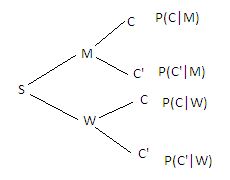
Problem 5% of men and .25% of women are colorblind.A color blind person is chosen at random. what is probability of this person being male.Assume equal number of men and women.
Solution
we need to find P(M|C)
P(M|C) = P(MC)/P(C)
given data is
P(C|M) = .05     P(C|W) =.0025    P(M)=P(W) =.50
P(C) = P(M)P(C|M) + P(W)P(C|W)
P(MC)= P(C/M)P(M)

           
Observation
When probability is given like t% of A are B
it means P(B|A), when A is the sample space then it becomes P(B)
Like in the problem above when it says
5% of student are women, we are given P(W|S) i.e P(W)
.25% of women are colorblind, we have P(C|W)


Problem Stores A, B and  C have 50, 75 and 100 employees, and, respectively, 50, 60 and 70% of these are women. Resignations are equally likely among all employees, regardless of sex.One employee resigns and this is woman. what is probability that she works in store C
Solution we need to find P(C|W)
P(C|W) = P(CW)/P(W)

given data is
P(W|A) = .50    P(W|B) = .60   P(W|C) =.70
n(A) = 50          n(B)=75           n(C)=100

P(W) = P(AW) + P(BW) + P(CW)
         = P(W|A)P(A) + P(W|B)P(B)+P(W|C)P(C)

P(A) = n(A) / (n(A)+n(B)+n(C)) similarly for P(B) and P(C)

P(CW)= P(W|C)P(C)


Problem Two cards are chosen at random without replacement
Events: B both cards are ace, A ace of spades is chosen, C atleast one ace is chosen
Find P(B/A),P(B/C)
Solution
 P(B/A) probability that both cards are ace when given that ace of spade is chosen

P(B/A) = P(AB)/P(A) = |AB| / |A|

|A| is number of outcomes in which ace of spades is chosen out of 2 chosen cards = 1*51
since there are two possibilites for ace of spade, it can be first or second card so  2*51 outcomes
|AB| = choose ace of spades and one other spade from remaining 3 = 1*3
and ace of spade can be first or second card so 2*1*3

P(B/A) = 3/51

ii)P(B/C) = P(BC)/P(C) =|BC|/|C|
here lets take case when order doesnot matters whether its first ace or second
Atleast one ace means total hands of card - none ace card
= (52 2) - (48 2) = 198
or we can find exactly one ace + exactly two ace to get atleas one ace
P(B/C) = (4 2) / 198

Some terminology
Probability Distribution(pd)
pd of a random variable X is description of the probabilities associated with possible values of X
sum(P(X=i)) = 1 ; for all possible values of X
that is sum of probability distribution over all the values of random variable is always 1
problems on Probability density
www.ma.utexas.edu/users/geir/teaching/m362k/dailyhw9solns.pdf   

Probability mass function(pmf)
PD can be described by function that specifies probability at each possible value of X
fX(x) = P(X=x)

Variance of X
sum{over all random values} x^2f(x) - (Ex)^2

Var(X) = E[ (X - E(X))2] = E(X2) - E(X)2
 Properties of Variance
E(cX) = cE(X)
E(c) =c
E(X+Y)=E(X)+E(Y)
var(c) = 0
var(cx)=c^2 * var(x)
var(x+y) = var(x) + var(y) if x and y are independent


 Probability Distributions


Bernoulli Trial and Binomial distribution
Each performance of an experiment with only two independent outcome is bernoulli trial

Probability of k success in n independent trials
For n independent trial where result is either Failure or Success we have bijection with bitstring, let 1 represent success and 0 failure then in bit string of size n we need to have exactly k 1's which is C(n k)
and probability for n trials will be pkqn-k
binomial distribution b(k,n,p) = C(n k)pkqn-k
Fig Bernoulli trial

Expected Value and Variance of B(n,p)

If X is binomial random variable with probability p and total experiment n then expected value and variance depends on p and n only with following equation

E(X) = np  because each trial results in random value 1 and 0 so mean for single trial is
1*p+0*(1-p )= p so for n trial its np
 and Variance = np(1-p)
because variance for single trial is (x-u)^2 *f(x) that is (1-p)^2*p+(0-p)^2 * (1-p) =p(1-p)

Geometric Distribution 
Instead of fixed number of trials as in bernoulli here trials are conducted until success is obtained
In Bernoulli trial we have k success but here we run the trial until first success

When we have n-1 failures and 1 success on nth trial we have probability as
(1-p)^n-1*p this is known as geometric distribution
for x = 1,2,3 ..

distribution is
x        p(x)
----------
1       p
2       (1-p)p
3        (1-p)^2*p
4        (1-p)^3 * p
.
n         (1-p)^n-1 * p

Sum of probabilities
when infinite number of trials
sum(0;-) ( p+(1-p)p+(1-p)^2 * p .................... )    = 1
when k failures and then success
sum(0;k)P(X=r) = ( p+(1-p)p+(1-p)^2 * p ...................(1-p)^k * p)    = 1- (1-p)^k+1

Expected Value
E(x) = (i=1 to n)xP(x)
       = p + 2(1-p)p + 3 (1-p)^2 p + .......n(1-p)^n-1 p
multiply both side by (1-p)
(1-p)E(x) = (1-p)p + 2(1-p)^2 p + 3 (1-p)^2 p + .......n(1-p)^n p)
subtracting 2 from 1
E(x)  - (1-p)E(x) = p + (1-p)p + (1-p)^2 p ............n(1-p)^n p)
consider n to be infinity
pE(x) =  p(1+(1-p) + (1-p)^2+ ,...........)
          = p(1/p)
E(x) = 1/p

Variance is (1-p)/(p)^2

Negative Binomial distribution 
until  r success from n trials
E(x) = r/p and Variance = r(1-p)/p^2
f(x) = C(x-1,r-1)(1-p)^x-r * p^r

Hypergeometric Distribution


Problems on Random Variable and Expected Value

Problem Two balls are chosen from the urn containing 8 white 4 black and 2 orange balls.Suppose that we win 2 points for each black ball and lose 1 point for each white ball. X denotes our winnings what are possible values of x and probability associated with each
Solution
Find sample space for 2 selected balls then find X that is winning for that selection
Lets say for selection (W,B) and (B,W) we get the wining X as +1
P(X = 1) = P(W,B)+P(B,W) = 2* 8/14*4/13  =. 3516
similarly for others we can find

Problem Consider value of random variable as

i)Find P(X>0) where P(R) = 18/38 and P(R') = 28/38
Solution P(X>0) = P(X=1) which is
P(R) + P(R'RR) assuming independent event we can write P(R'RR) = P(R')P(R)P(R)

ii)Find E(X)

E(x) = (1,n) Σ xP(X=x)
we construct probability distribution
x          P(x)
---------------------------
+1       P(R)+P(R'RR) 
-1       P(R'R'R)+P(R'RR')
-3        P(R'R'R')


Problem Consider 4 bus  carrying 40, 33, 25, 50 students resp.One of the student is selected at random Let X denote number of students in the bus carrying this randomly selected student. One of the bus driver is also randomly selected. Let Y denote number of students on this bus
Find E(X) and E(Y)
Solution 
value of X is number of students in the bus since students can be selected from any of the bus
so
x         p(x)      
----------------------
40       40/148       
33       33/148
25        25/148
50        50/148

E(x) = 39.28

Value of Y is also same as X but probability of selection of driver from a particular bus is 1/4 since there are only 4 drivers one for each bus

x         p(y)    
--------------------

40        1/4

33       1/4

25        1/4

50        1/4

Variance(X)


Problem Suppose we toss fair coin until head comes up. X represent number of tosses what is E(x)distribution
x              p
1             1/2 (H)
2             1/2*1/2 (TH)
3             1/2*1/2*1/2 (TTH) ......

E(x) = (0 to .. ) i(1/2^i)
        = 1/(1/2) = 2

Problem Each sample of water has .10 chance of containing pollutant Find probability that in next 18 sample atleast 4 contain pollutant
Solution
X number of sample that contains pollutant its bernoulli trial with p=.10 and q =.9 n =18
P(X >= 4) =   sum(x=4;18) (18 x) p^x q^18-x
or P(X>=4) = 1 - P( X < 4)


Poisson Distribution

Example
Let t be expected number of occurrence of event year
divide in to n equal intervals and assume that in any given interval the number of occurence of event is either 1 or 0 The probability of occurrence of event is then  t/n
subjected to above assumption binomial distribution gives the probability of there being r occurence of event in n intervals
The assumption is important because if two occurrences of event can happen in single interval then trinomial distribution would be required.To ensure this assumption is valid n must be sufficiently large such that the intervals are sufficiently small

P(X=r) = C(n r) (t/n)^r (1-t/n)^n-r
by solving it we get  (t^r/r!) e^-t

Sum of probabilities
(1+t/1! + t/2! + .....)e^-t  =e^t * e^-t =1


//normal distribution

Geometric Probability
Problem Two friends agree to meet at a park with the following conditions. Each will reach the park between 4 pm and 5 pm and will see if the other has already arrived. if not, they will wait for 10 minutes or the end of the hour whichever is earlier are leave. what is the probability that the two will not meet?
Solution
We do not have any discrete time intervals in this problem the event space is on real axes. we can fin d answer to such question using the plot on real axes
Let x axis represent the time line for P1 and y axis be time line for P2
points on line y=x show the time when both of them arrive at the same time
In condition we are given that they wait for interval of time 10minutes that is if P1 arrives at time t then P2 either should arrive 10min before or 10min after P1. So our region is now bounded
which is total area - 2*area of remaining triangles
that is 60*60 - 2*(1/2* (60-10)*(60-10)) = 3600 - 2500 =1100
probability is 1100/3600 = 11/36

Normal Distribution
symmetric bell shaped curve

represented as N(mean, variance) or X ~ N(m,sd^2) meaning X is normally distributed with mean m and standard deviation sd
about 2/3rd of all cases fall within one standard deviation of mean
P(mean - sd <=X <= mean+sd) = .6826
about 95% fall within 2sd
P(mean - 2sd <=X <= mean+2sd) = .9544

Standard Normal variable 
 convert into standarized normal variable
z = (x- m)/sd
this changes X in to standarized normalization with m=0 and sd =1
z ~ N(0,1)

Properties
i) p(z<=a) = f(a) when a is positive
                = 1-f(-a) when a is negative
because 1-f(a)  will be symmetrical to f(-a)  for a>0
ii)p(z>=a)  = 1-f(a)
iii)p(a<=z<=b) = f(b) -f(a)
iv)p(-a<=z<=a) = 2f(a) -1

Problem  Consider X~  N(25000, 10000^2). Find P(x<=10000))
standard variable z = (x-25000)/10000
now for x =10000 we have z = -1.5 so
p(x<=10000) = p(z<=-1.5) =1-f(1.5)

Problem In family with 11 children what is probability that there will be more boys then girls
Mean for binomial distribution is Np = 11*1/2 = 5.5
variance =Npq = 5.5*1/2 = 2.75
for binomial it is P(x>=6)
for normal we would say P(z>=5.5)